

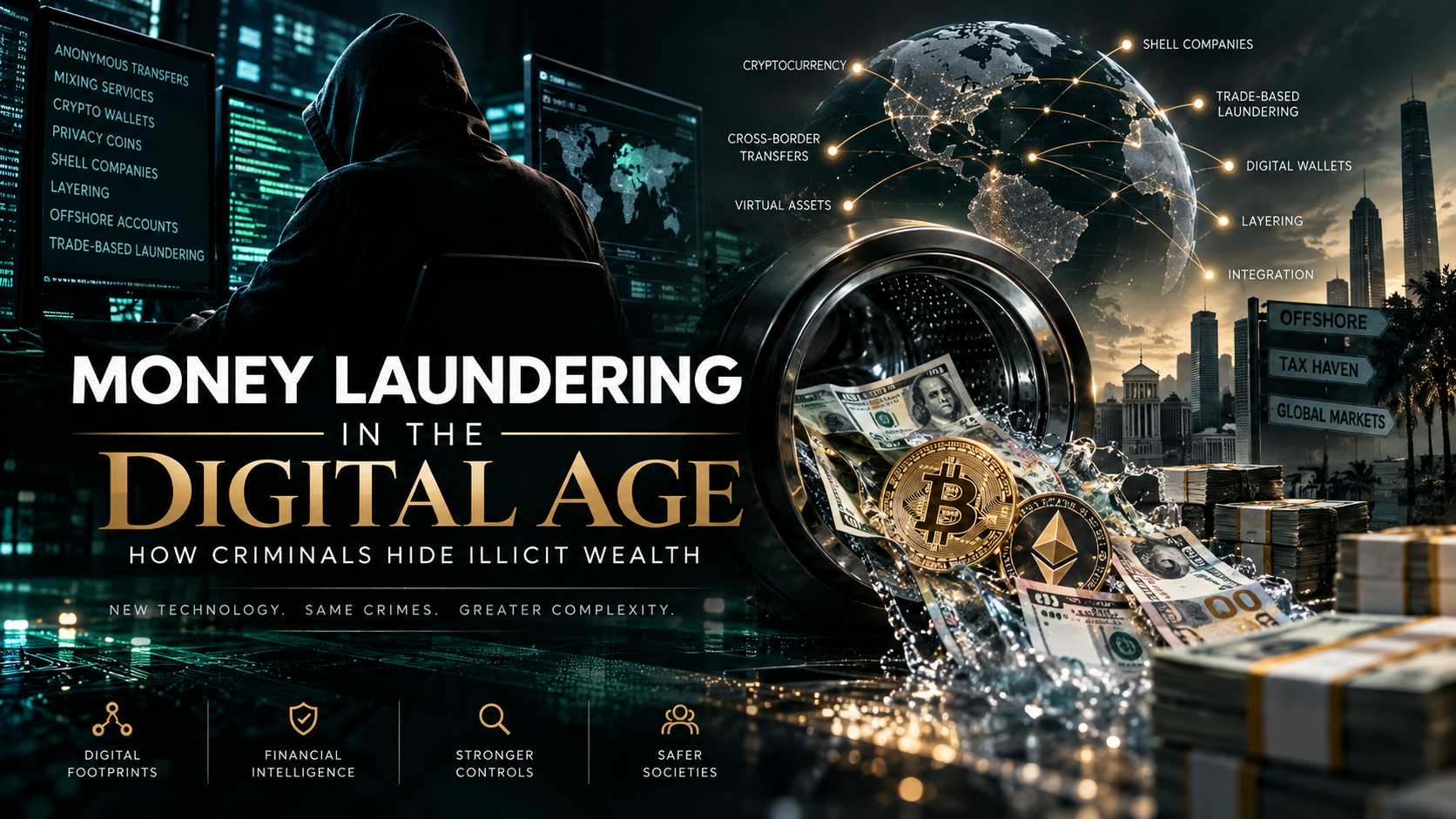
Money Laundering in the Digital Age
How criminal finance adapts across channels and
borders
Money laundering has long
depended on concealment: separating illicit proceeds from their criminal
origins and making them appear legitimate. Digital channels have changed the
speed, scale and complexity of that task. They have also widened the forms of value
that can move, from cash and bank deposits to electronic payment balances,
digital wallets, cryptocurrencies and some game-related assets. These products
are not interchangeable: the Financial Action Task Force (FATF) defines virtual
assets by how they can be transferred or traded and used, and excludes some
digital representations of fiat currency and other regulated financial assets. [1]
The objective is familiar and the routes are changing
Placement, layering and
integration remain useful ways to describe laundering, but in practice the
stages can overlap. Cash-intensive businesses, false invoices, property, shell
companies and complex ownership structures still matter. Criminals may combine
them with bank accounts, fintech services, mobile payments, virtual assets and
third-party accounts, moving value across several systems before it is
presented as legitimate wealth.
Digital does not necessarily
mean anonymous. Payment services, banks, exchanges and public blockchains can
create records that investigators may use to identify relationships and
reconstruct transactions. The challenge is often to connect fragmented records
across platforms, people and jurisdictions. Unusual activity can signal a need
for investigation, but it does not by itself prove money laundering.
Methods adapt to the crime and the region
The laundering method depends
on both the crime that generated the proceeds and the infrastructure available
along the route. Drug profits, smuggled commodities and cybercrime proceeds
create different practical problems. So do differences in access to banks,
mobile money, remittance services and digital platforms.
Where formal financial services
are limited, cash, trade settlement and informal transfer networks such as
hawala may be more practical. As funds cross borders, those networks can
operate alongside or connect with formal financial services; the pattern is not
a simple progression from informal transfers to digital banking. FATF describes
hawala and similar providers as distinct from, but sometimes interconnected
with, the formal sector. UNODC reporting on drug-trafficking payments
illustrates regional variation: Afghan authorities described hawala as the main
channel, while Russian authorities reported greater use of electronic payment
instruments and virtual assets. [2],
[3]
Gaming tokens and organised crime evidence
Game currencies and virtual items can be bought, transferred or resold, sometimes through markets outside a game’s official platform. Yet the public evidence linking these systems to organised crime is uneven. The examples below include financial-intelligence cases, cybercrime reporting and risk typologies; they do not all establish the same level of proof or the same kind of criminal activity.
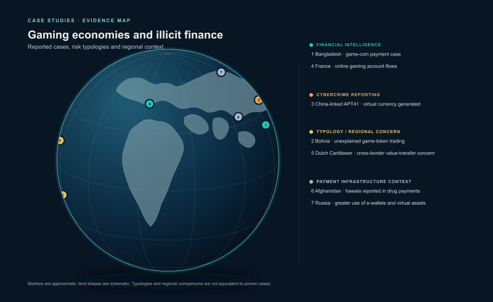
Figure
1. Reported cases, typologies and payment-infrastructure context. Markers and
land shapes are schematic; the categories represent different kinds of
evidence.
In Bangladesh, the Financial
Intelligence Unit described payments for online-game coins routed through
mobile financial accounts and then to foreign-currency accounts belonging to
game companies. The purchases were reportedly presented as software imports.
The report names products including PUBG UC, Free Fire and Razer Gold, but its
published summary does not link the activity to an organised crime group or
smuggling proceeds. [4]
An Organization of American
States case compendium describes a Bolivian video-game trading typology:
high-volume purchases of game tokens and credits, with the source of funds
unknown and inconsistent with the operators’ apparent means. The underlying offence
is listed as undetermined, so this is a suspicious pattern rather than proof of
a specific crime. [5]
Mandiant’s reporting on APT41
describes a China-linked cyber threat group with financially motivated activity
targeting the video-game industry. RUSI reports that, in one incident, the
group generated tens of millions of dollars’ worth of a game’s virtual
currency, which was likely sold through underground markets. This is a
cybercrime report, not evidence that the proceeds came from drug or commodity
trafficking. [6],
[9]
France’s financial intelligence
unit, TRACFIN, described an investigation involving about €500,000 in flows
through online gaming websites. Investigators found large cash purchases of
prepaid codes, little apparent gameplay and activity spanning several countries.
The case was referred to prosecutors for suspected laundering through online
gaming websites; the report does not identify a commodity-smuggling predicate. [7]
A study of organised crime in
Latin America describes the possible purchase and resale of in-game commodities
using false or stolen identities and prepaid cards. It also notes that
drug-trafficking networks may transfer virtual currency to associates in other
countries through virtual worlds. The study identifies this as a regional
concern highlighted by authorities in the Dutch Caribbean, not a named
prosecution proving that a particular trafficking group used the method. [8]
RUSI also discusses reporting
on stolen payment-card details used to buy Fortnite V-Bucks or in-game items
for resale. That pattern points to fraud involving gaming platforms; it does
not establish a link to a transnational trafficking group or to proceeds from
counterfeit medicines or goods. [9]
The public-record gap matters.
The sources reviewed here do not substantiate a specific gaming-token case tied
to African oil, diamond or precious-metal smuggling, or to counterfeit
medicines or counterfeit goods in Asia, the Middle East or elsewhere. That is a
limit of the available public evidence, not proof that no such cases exist.
Online gambling should also be distinguished from in-game currencies and
virtual items: reports sometimes use “gaming” for both, although the products
and laundering mechanisms differ.
Following the money through fragmented systems
Rapid onward transfers,
fragmented payments, circular transactions and recurring counterparties can
reveal patterns that isolated transactions may hide. Network analysis can help
identify relationships between people, companies and accounts that initially
appear unrelated. Analysts still need to assess those patterns against
supporting records and the broader investigative context.
Virtual assets add another
layer. Many public blockchains preserve transaction histories, while exchange
records, bank statements and customer information can help connect addresses to
real-world activity. Used together, these records can turn a complex digital
trail into an investigative lead.
D-finitive Insights
At D-finitive, we see the
challenge in modern money-laundering investigations as more than a lack of
data. It is the work of turning fragmented financial information into a
coherent account of what happened: where funds originated, how they moved,
which accounts interacted and who ultimately benefited.
Effective transactional
analysis goes beyond identifying isolated suspicious payments. It connects
financial activity to counterparties, entities, timelines and supporting
evidence. Technology can surface anomalies and relationships; professional
judgement remains essential to determining what they mean.
The aim is to turn complex
financial data into clear, defensible intelligence that supports investigations
and informed decisions. In our next article, we will examine money-laundering
methods linked to smuggling networks in Africa.
Delivering Clarity. Protecting
Integrity. Driving Accountability.
Sources
[1] FATF, Virtual Assets and FATF
Glossary. Open
source
[2] FATF, Investigating
Professional Money Laundering, Underground Banking, and Hawala. Open
source
[3] UNODC, Payment Modalities,
Money Laundering and the Use of Drug-Trafficking Proceeds. Open
source
[4] Bangladesh Financial
Intelligence Unit, Annual Report 2021-22, Case 11. Open
source
[5] Organization of American
States, DTOC Case Compendium, Bolivia entry. Open
source
[6] Mandiant, APT41: A Dual
Espionage and Cyber Crime Operation. Open
source
[7] TRACFIN, Annual Report 2017,
Case Study 7. Open
source
[8] Latin America Organised Crime
Study for the Kingdom of the Netherlands. Open
source
[9] RUSI, Gaming the System: Money
Laundering Through Online Games. Open
source