

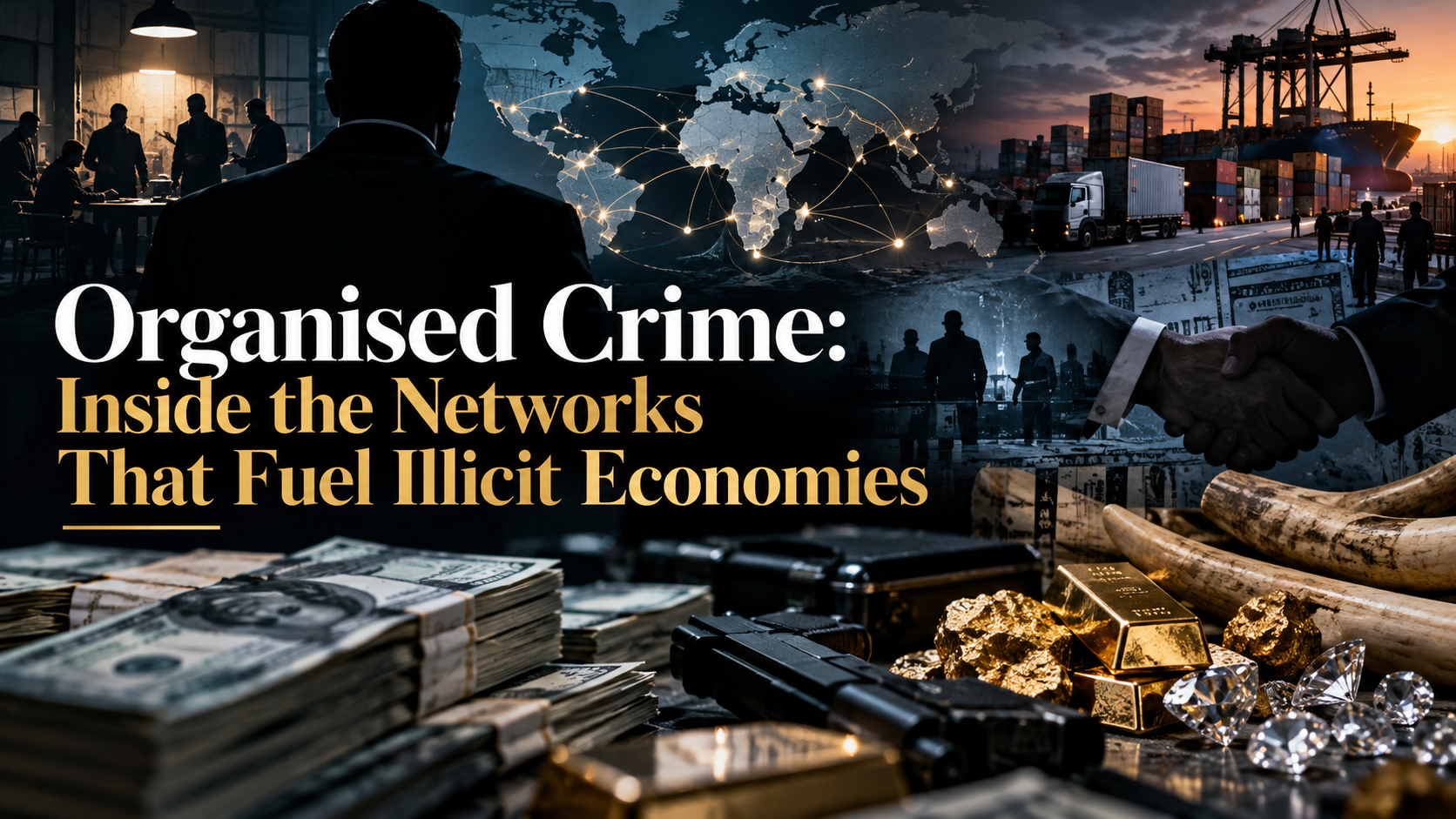
Organised Crime:
Inside the Networks That Fuel Illicit Economies
Organised crime is no longer confined to the shadows of
society. It has evolved into a sophisticated, interconnected criminal
economy, operating across borders, industries, financial and digital systems.
Behind seemingly legitimate businesses, commercial transactions and
international trade, criminal networks can conceal activities that generate
enormous illicit profits.
From illegal mining and commodity smuggling , such as
gold, diamond and oil smuggling, to drug trafficking, corruption and illicit
trade, organised criminal groups exploit weaknesses in governance, regulation,
and law enforcement. Their operations increasingly resemble legitimate
enterprises, supported by complex networks of intermediaries, financial
facilitators and individuals positioned to protect their interests.
South Africa and the wider African continent face particular
challenges as criminal networks exploit valuable natural resources, established
trade routes and vulnerabilities within both public and private institutions. From
exploiting porous borders to transcending jurisdictions using digital
platforms. The consequences extend far beyond financial losses, undermining
economic development, weakening institutions, and eroding public trust.
Understanding organised crime requires looking beyond the individuals’
committing offences to the networks, financial relationships and structures
that enable criminal enterprises to survive and expand.
Because behind every successful criminal enterprise lies
a network that makes it possible.
The Criminal Networks Operating in Plain Sight
Organised crime does not always operate through violence or
intimidation. Some of its most effective networks function through legitimate
businesses, professional relationships, and commercial activities, making
criminal operations difficult to distinguish from ordinary economic activity.
These networks often rely on individuals performing
different roles — from those directing criminal activities to intermediaries
who facilitate transactions, transport illicit goods, or provide access to
financial systems. Corrupt officials, compromised business relationships,
and professional facilitators can further enable criminal enterprises to
operate with reduced scrutiny. Compounding these networks infiltrates various
law enforcement agencies or worse when law enforcement agencies itself run
illegal operations using State resources and their place in society.
What makes organised crime particularly difficult to
dismantle is its ability to adapt and replace individuals without disrupting
the wider operation. Importantly, law enforcement authority must understand
the crime group’s typology coupled with the organised crime’s architecture to
develop an appropriate anti-organised crime group. Removing one participant may
have little impact when the financial resources, commercial connections and
underlying criminal infrastructure remain intact.
For investigators, this means identifying the modus operandi,
critical supply chains, and individual offenders is only part of the challenge.
Understanding who controls the operation, who facilitates its activities and
who ultimately benefits financially is essential to exposing the broader
criminal network.
Organised crime survives not
simply because criminals operate in secrecy, but because their networks can
operate within systems designed for legitimate business.
The Illicit Economy: Where Crime Becomes Big Business
Organised crime is driven by one fundamental objective: profit.
Behind criminal activities lies an underground economy in which illegal goods,
services and financial transactions generate revenue for networks operating
across national borders.
In South Africa and across Africa, activities such as illegal
mining, gold and diamond smuggling, drug trafficking, wildlife trafficking, and
counterfeit trade illustrate how criminal enterprises exploit valuable
resources and legitimate commercial markets. These activities often depend on
established supply chains, transportation networks, and intermediaries capable
of moving illicit goods into domestic and international markets.
The consequences reach far beyond the criminal transactions
themselves. Illicit economies deprive governments of revenue, undermine
legitimate businesses, distort competition, and expose communities to
exploitation and violence. Criminal profits can also strengthen the
influence of syndicates, enabling them to expand operations and compromise
institutions intended to regulate or investigate their activities.
What makes these economies particularly concerning is the intersection
between legal and illegal commerce. Illicit goods may enter legitimate
supply chains, while apparently ordinary business transactions can conceal the
movement of criminal proceeds.
The real danger of organised crime is not only the wealth
it generates illegally, but the influence that illicit wealth can purchase
within the legitimate economy.
When Organised Crime Infiltrates Legitimate Business
One of the most concerning aspects of organised crime is its
ability to penetrate legitimate businesses and exploit established
commercial systems. Criminal networks may use companies, business partnerships,
and professional intermediaries to facilitate illegal activities, conceal ownership,
or create the appearance of lawful transactions.
Businesses operating in transport, logistics, construction,
mining, property, and international trade can be particularly vulnerable
where complex supply chains, high-value transactions or weak oversight create
opportunities for exploitation. Criminal involvement may take the form of
undisclosed ownership interests, fraudulent contracts, compromised procurement
processes or the misuse of legitimate business accounts.
Corruption can further strengthen these criminal networks. Bribery,
conflicts of interest and the abuse of authority may enable criminal
enterprises to secure contracts, avoid scrutiny or gain access to commercially
valuable information. In some instances, organisations may become involved
unknowingly through suppliers, contractors, or business partners whose
activities have not been adequately scrutinized.
For organisations, the risk extends beyond direct financial
loss. Regulatory exposure, reputational damage, operational disruption, and
potential criminal liability can arise when illicit activities become
embedded within legitimate commercial relationships.
A business does not need to be criminally controlled to
become a vehicle for organised crime — sometimes, weak oversight and
compromised relationships are enough.
Following the Networks: How Investigators Connect the Dots
Investigating organised crime requires more than identifying
individual offences. The real challenge lies in uncovering the criminal
enterprise’s operations, typology and architecture that forms the foundation
for relationships including financial connections and operatingl structures
that link seemingly unrelated activities to a larger criminal enterprise.
Criminal networks often leave fragmented evidence across financial
transactions, company records, communication histories, procurement activities,
and commercial relationships. When examined collectively, these records can
reveal patterns of coordination, shared interests and connections between
individuals or entities that initially appear independent. Many of the activities
are camouflaged using fake or artificially inflated invoices supported by bills
of quantities or materials and shipping documents hiding the true contents of shipping
containers.
Financial investigations, forensic accounting,
intelligence gathering, and network analysis play an important role in
connecting these pieces. By examining transaction patterns, ownership
structures, business relationships and the movement of assets, investigators
can identify potential facilitators, trace criminal proceeds, and establish how
different participants contribute to the wider operation.
However, identifying suspicious connections is not the same
as proving criminal involvement. Reliable evidence, careful analysis, and
professional judgement remain essential to distinguishing legitimate
commercial relationships from activities that may support organised crime.
The breakthrough in an organised crime investigation
often comes not from finding another suspect, but from uncovering the
connections that reveal how the entire network operates.
Disrupting Organised Crime: Why Financial Intelligence Matters
Organised crime thrives on its ability to generate, move
and protect illicit wealth. Arresting individual offenders may interrupt
criminal activities, but dismantling an entire network requires identifying the
financial resources and structures that sustain its operations.
Financial intelligence plays a critical role in exposing
these networks. Suspicious transaction patterns, unexplained wealth,
complex ownership structures, and unusual commercial relationships can provide
valuable insights into how criminal enterprises operate. When combined with
investigative evidence, this information can help identify key participants,
financial facilitators and assets potentially linked to criminal activity.
Effective disruption requires cooperation between law
enforcement, financial institutions, regulatory authorities, and the private
sector. Sharing relevant intelligence through lawful channels,
strengthening due diligence, and identifying vulnerabilities within commercial
systems can make it more difficult for criminal networks to exploit legitimate
businesses.
Ultimately, combating organised crime is not simply about
responding to individual offences. It requires a coordinated approach that
targets the people, profits, and enabling structures behind criminal
enterprises.
Because disrupting a criminal operation may stop one
crime — but dismantling the financial network can threaten the enterprise
itself.
D-finitive Insights
At D-finitive, we recognise that organised crime is not
simply a collection of isolated criminal activities. It is a complex network
of monetary interests, commercial relationships, and individuals whose
connections enable illicit enterprises to operate and expand.
Exposing these networks requires looking beyond individual
transactions or incidents. Through forensic investigations, financial
analysis and the examination of business relationships, investigators can
uncover patterns that reveal how criminal activities are facilitated, concealed,
and financially sustained.
For organisations, the challenge is equally significant. Understanding
who they do business with, identifying unusual financial activity and
strengthening internal controls are essential to reducing exposure to
criminal networks operating within legitimate markets.
Our perspective is that effective investigations must go
beyond identifying wrongdoing. They should establish how the network
operates, who enables it and who ultimately benefits — transforming
fragmented evidence into actionable intelligence that supports accountability.
Because organised crime is sustained by connections — and
exposing those connections is where meaningful disruption begins.
Delivering Clarity. Protecting Integrity. Driving Accountability.