

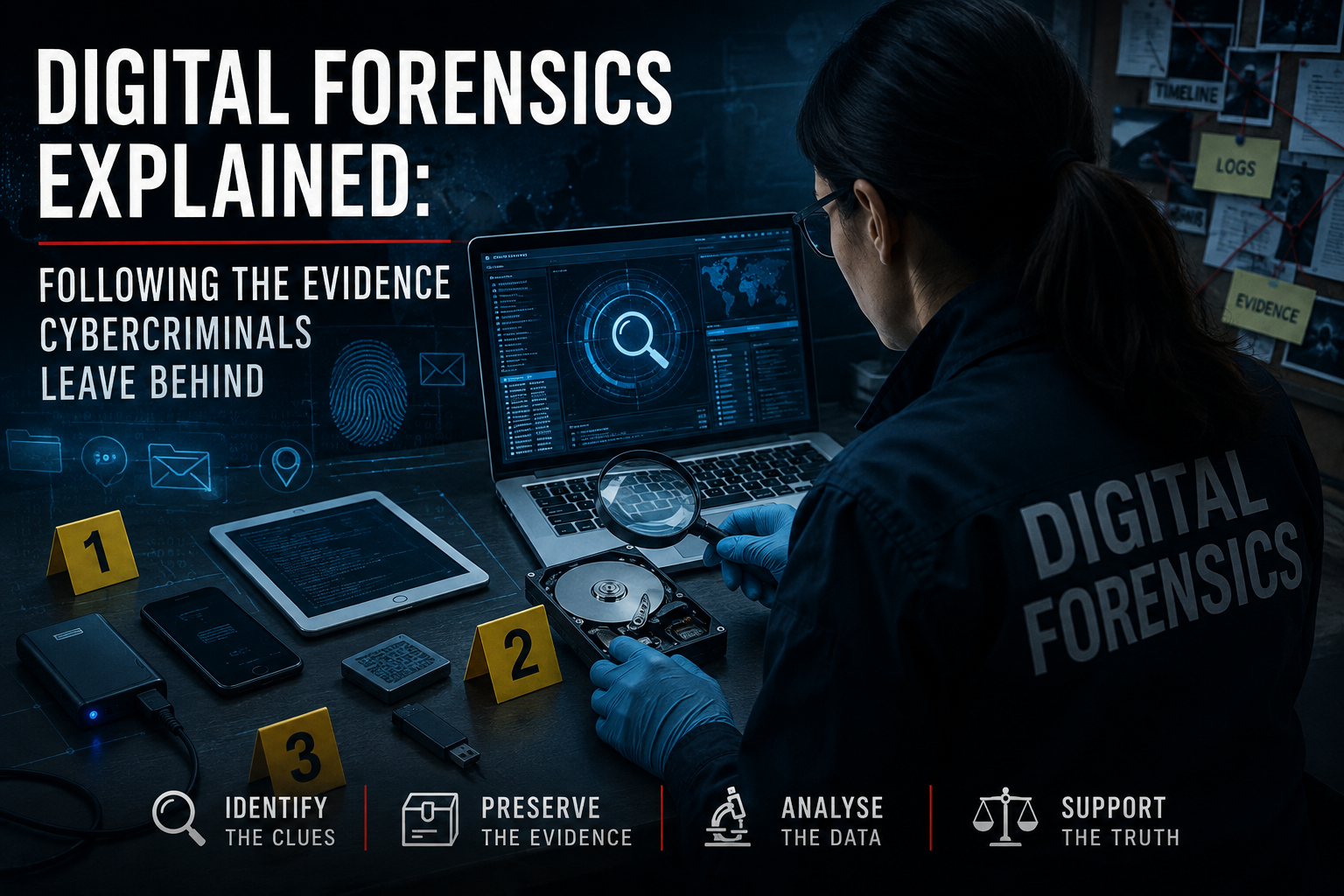
Digital Forensics
Explained: Following the Evidence Cybercriminals Leave Behind
Every Digital Action Leaves a Trace
A fraudulent payment is processed.
A confidential document is copied.
An employee deletes an email.
Someone logs into a system using
compromised credentials.
A file disappears.
To the organisation, these events
may initially appear disconnected. To a digital forensic investigator, they may
form part of the same story.
Modern organisations generate
enormous volumes of digital information every day. Computers, mobile devices,
email systems, applications, network infrastructure and cloud environments can
all contain information capable of helping investigators reconstruct what
happened before, during and after a suspected cyber incident. Digital evidence
can include documents, emails, images and application data, as well as
information stored on computers and mobile devices (Lyle et al., 2022).
Digital forensics is the
disciplined process of identifying, preserving, examining and analysing
electronic information so that meaningful evidence can be extracted from it.
The forensic process requires potentially relevant data to be appropriately
identified and protected before examination and analysis take place. Preserving
the integrity of that information throughout the process is fundamental,
particularly where the findings may ultimately support disciplinary,
regulatory, civil or criminal proceedings (Guttman et al., 2022).
What makes digital evidence
particularly powerful is that it can reveal far more than what is immediately
visible on a screen. Investigators may be able to establish when a document was
created or modified, the creator or author, and the
modifier, identify patterns of system activity, reconstruct
communications, recover information that may have been deleted or correlate
evidence from different sources to develop a timeline of events.
But digital forensics is not simply
about recovering deleted files or searching through someone's computer.
It is about reconstructing
events.
Who accessed the information?
What happened?
When did it happen?
What systems or accounts were
involved?
What evidence remains?
And, critically, what does that
evidence tell us?
In an environment where
cybercriminals increasingly attempt to conceal their activity, digital evidence
can provide something assumptions cannot:
a trace of what actually happened.
Following the Digital Trail
Digital evidence rarely tells its
story through a single file or device. The real value of a forensic
investigation often emerges when information from multiple sources is
examined together and placed into context.
An investigator may begin with a
compromised computer, but the evidence could extend far beyond it. System
and application logs may record successful and failed login attempts. Email
records may reveal communications preceding an incident. File metadata
can provide information about when documents were created, accessed or
modified, while network activity may help establish connections between
systems. Even information that a user attempted to delete may, in some
circumstances, remain partially or fully recoverable. Examining and correlating
information from different digital sources can therefore provide
investigators with a more complete understanding of an incident (Lyle et
al., 2022).
The challenge is not simply finding
data—it is establishing its relevance and determining what it means in context.
Consider an employee suspected of removing confidential information before
leaving an organisation. A forensic examination might identify that a sensitive
document was accessed shortly before departure. On its own, that fact
proves very little. But if the timeline also shows that an external storage
device was connected minutes later, relevant files were copied, unusual account
activity occurred and certain records were subsequently deleted, the combined
evidence may begin to establish a sequence of events.
This is why timelines and
correlation are so important. Investigators compare timestamps, user
activity, system events, communications and other digital artefacts to
determine whether apparently isolated actions are connected. However, forensic
findings must be interpreted carefully: timestamps can be inaccurate or
altered, deleted data may be incomplete, and a digital artefact does not
automatically establish who was physically responsible for an action. Digital
forensic analysis therefore requires appropriate technical interpretation, with
investigators recognising both the capabilities and limitations of the evidence
available to them (Lyle et al., 2022).
Digital forensics therefore
involves far more than searching for incriminating material. It is the
disciplined process of testing evidence against the questions an investigation
is trying to answer, identifying relationships between different sources and
distinguishing what the evidence demonstrates from what investigators
may merely suspect.
Sometimes the most important
finding is not a deleted document or suspicious email.
It is the timeline that connects
them.
When Digital Evidence Tells the Story
The value of digital forensics
becomes clearest when electronic evidence moves an investigation beyond
suspicion and towards demonstrable facts.
A South African Special Tribunal
matter provides a practical example. In proceedings involving the Special
Investigating Unit (SIU), the Tribunal recorded evidence from an SIU
digital forensics practitioner who had been tasked with imaging, examining and
analysing hard drives from a computer allocated to an employee in the Office of
the State Attorney. The forensic examination focused on particular documents
and sought to determine who had authored them and who had last modified or
saved them. The practitioner documented both the methodology used and the
findings of the examination
This is digital forensics in
practice. The investigation was not simply searching a computer for suspicious
material; digital evidence was being used to answer specific investigative
questions about the origin and history of documents. When combined with other
evidence—such as financial records, communications, witness evidence and
transactional analysis—these findings can contribute to a much broader
reconstruction of events.
The case also demonstrates why
digital evidence extends well beyond conventional cybercrime investigations. It
can play an important role in fraud, corruption, procurement irregularities,
employee misconduct, financial investigations and civil proceedings. In an
increasingly digital business environment, an investigation into seemingly
traditional misconduct may ultimately depend on evidence contained within
computers, mobile devices, email accounts, applications or other electronic
systems.
Evidence Is Only Valuable If You Can Trust It
Finding relevant digital evidence
is only part of a forensic investigation. For that evidence to carry weight,
investigators must also be able to demonstrate that it has been properly
acquired, preserved and handled, and that the information examined is a
reliable representation of the original data.
This begins with preservation.
Rather than examining an original device directly wherever practicable,
forensic practitioners may create a forensic image—a controlled copy of the
data that can be analysed while protecting the original evidence from
unnecessary alteration. Cryptographic hash values can help verify the integrity
of acquired digital evidence by providing a means of detecting whether the data
has changed during subsequent handling and examination. Maintaining the
integrity of digital evidence throughout its lifecycle is fundamental to
ensuring that it remains reliable and capable of supporting an investigation
(Guttman et al., 2022).
Equally important is the chain
of custody—the documented record of how evidence moves from collection
through preservation, examination and analysis. This includes recording who
collected or handled the evidence, when and where it was obtained, how it was
stored or transferred and the purpose of each transfer (Guttman et al., 2022).
These safeguards are critical.
Poorly handled digital evidence can create uncertainty about whether
information has been altered, contaminated or taken out of context, potentially
undermining the reliability of an investigation. Organisations should therefore
avoid casually searching, copying or modifying potentially relevant devices or
data when serious misconduct or a cyber incident is suspected. Early
involvement of appropriately skilled forensic practitioners can help preserve
evidence while ensuring that the investigation proceeds in a controlled and
defensible manner.
Ultimately, digital forensics is
not about finding the most dramatic piece of evidence. It is about establishing
facts through a process that is methodical, documented and capable of
withstanding scrutiny.
D-finitive Insight
Digital evidence has become
integral to modern investigations. Whether the matter involves cybercrime,
fraud, corruption, employee misconduct or financial irregularities, valuable
evidence may already exist within an organisation’s digital environment.
At D-finitive Advisory, we believe forensic
readiness should begin before an investigation becomes necessary.
Appropriate information governance, data-retention practices, secure logging
and clearly defined incident-response procedures can help ensure that
potentially valuable evidence is available, preserved and capable of meaningful
analysis when an incident occurs.
Digital forensics should also never
be viewed in isolation. Its investigative value is strengthened when digital
findings are considered alongside financial records, documentary evidence,
witness accounts and other relevant information to build a reliable picture of
events.
The objective is not simply to
recover data. It is to use digital evidence responsibly and methodically to
help establish what happened, how it happened and, where the evidence
supports it, who was involved.
Follow the evidence. Establish
the facts. Protect the integrity of the investigation.
Delivering Clarity. Protecting
Integrity. Driving Accountability.